
Blog
“Learn every day, but especially from the experiences of others. It’s cheaper!”



Most Recent

Most disappointing advisor relationships aren't about bad actors. They're about advisors who managed investments but never built an actual written plan. Here's how to tell the difference between the wrong advisor and simply the wrong fit.

Planning around a CalPERS pension works differently than private-sector retirement. The CalPERS Financial Blueprint is a free seven-step guide for California public employees, covering how much you need to save, how to use Savings Plus, when to time your exit, and the pension elections you cannot undo. Download it and see where your plan stands.

A framework for the one CalPERS decision you can't take back, how to weigh the Unmodified Allowance against Options 1-4, and protect a survivor's income and health coverage.

One number in your CalPERS pension was set before your first day, and it's permanent. Here's how to tell which formula you have, and why it shapes when you retire.

Your retirement date sets several CalPERS numbers at once: service credit, your benefit factor, your first COLA, and your leave-payout taxes. They rarely point to the same day. Here's how to time it.

A lighter roundup for state employees curious about the small stuff beyond the pension and health plan. Here are the perks and discounts that kept coming up on r/CAStateWorkers, from travel and subscription deals to on-site amenities, plus how to confirm what actually applies to your department and bargaining unit.

If your CalPERS pension won't fully fund the retirement you're picturing, Savings Plus (or the CalPERS 457 Plan) gives you two ways to save more: a 401(k) and a 457(b). Here's why funding the 457(b) first tends to make sense for most participants who aren't maxing out both, and the cases where it doesn't.

Two portfolios can hold the same investments and still keep different amounts after taxes. The difference often comes down to asset location: which investments sit in your traditional, Roth, HSA, and taxable accounts. This piece walks through how each account type is taxed, the two lenses that guide placement decisions, and how to move an existing portfolio toward better location without triggering an avoidable tax bill along the way.

You've left your CalPERS-covered job before retirement, and now your benefits are in question. This plain-language guide walks through vesting, your three options at separation (leave contributions on account, take a refund or rollover, or retire now), and how reciprocity works if you're heading to another California public employer.

The S&P 500 closed the first half of 2026 up 10.21%, but the path was anything but smooth. A new Fed chair, an Iran war that pushed oil past $100, and growing scrutiny of AI earnings concentration all shaped the six months, and may shape the next. Here's a look back, plus the portfolio questions worth asking now.

A CSEA survey of nearly 5,000 California state employees found that 86% handle their own financial and retirement planning, relying on friends, family, and online resources. Here's the confidence gap between DIY planners and those who work with an advisor, and the CalPERS-specific decisions (pension timing, Savings Plus, Social Security, and tax planning) where going it alone may cost you.

"Just buy an S&P 500 fund and chill" or (VOO & Chill) is a popular strategy, but is it really just a concentrated bet on U.S. large-cap stocks? Here's what the lost decade, Japan's 34-year flat market, and decades of research on size and value suggest about using a single index for your entire portfolio.


You already know what you need to do with your money. Set up the account, look at the retirement contributions, make a plan. You've known for a while. This piece looks at why the gap between intention and action is so hard to close, what the research on financial procrastination and present bias actually says, and the one simple thing that tends to move people from "meaning to" into "done."



RSUs vesting every year, stock options you've been meaning to deal with, and a nagging sense you're overdue for a plan. The hard part usually isn't understanding the rules; it's follow-through, since there's always a reason to wait one more quarter. This piece covers how RSUs, NSOs, ISOs, and PSUs are taxed, why a concentrated position is riskier than it feels, and a three-sleeve framework for reducing it on a schedule you set in advance.

When couples combine finances, the real challenges are rarely about math. They're about autonomy, fairness, and trust. This guide walks through four approaches to merging money (from fully separate to fully joint), explains how financial needs shift across life stages, and outlines the legal risks of changing asset titling without professional counsel. Written for high-earning professionals navigating income disparity, career transitions, and the emotional weight of financial intimacy.

Ask people why they hired a financial advisor and almost none of them say "to beat the market." They say they wanted accountability, help making sense of complexity, or simply to stop spending their weekends on it. This piece walks through where research suggests professional management may add value over time, from cost-effective implementation and rebalancing to tax and withdrawal planning, and why the largest contribution tends to be keeping investors from costly decisions at market extremes.

You track your steps, hit the gym, and meal prep. Financial health rarely gets the same attention, even though money is the leading factor Americans point to when they talk about what's hurting their mental health. This piece reframes financial wellness as a form of wellness rather than a chore, walks through six areas it actually covers, and looks at what the research says about where guidance tends to help most.

A Roth conversion is one of those moves that sounds technical but comes down to a simple idea: pay tax on retirement money when your rate is low instead of when it's high. This piece covers how conversions work, when to skip one (the timing traps that catch people are just as important), and a second strategy, the mega backdoor Roth, that lets high earners who've maxed their 401(k) set aside a large additional amount each year.

A few strong years in the market tend to leave portfolios holding more stock, and more risk, than their owners intended. The start of a new year is a natural time to check whether your allocation has drifted, whether your cash is doing its job, and whether you're taking full advantage of the 2026 contribution limits. This piece is a practical review across diversification, rebalancing, tax efficiency, and retirement savings by career stage.


That all just happened in one week!

A government shutdown delayed key data, rate expectations shifted, and headlines stayed loud, yet 2025 ended up a solid year for disciplined investors. The more interesting story was where the returns came from: international stocks outpaced the U.S. by a wide margin, and bonds posted their best year since 2020. This recap looks back at what happened and why staying diversified, rather than chasing last year's leader, tends to hold up.


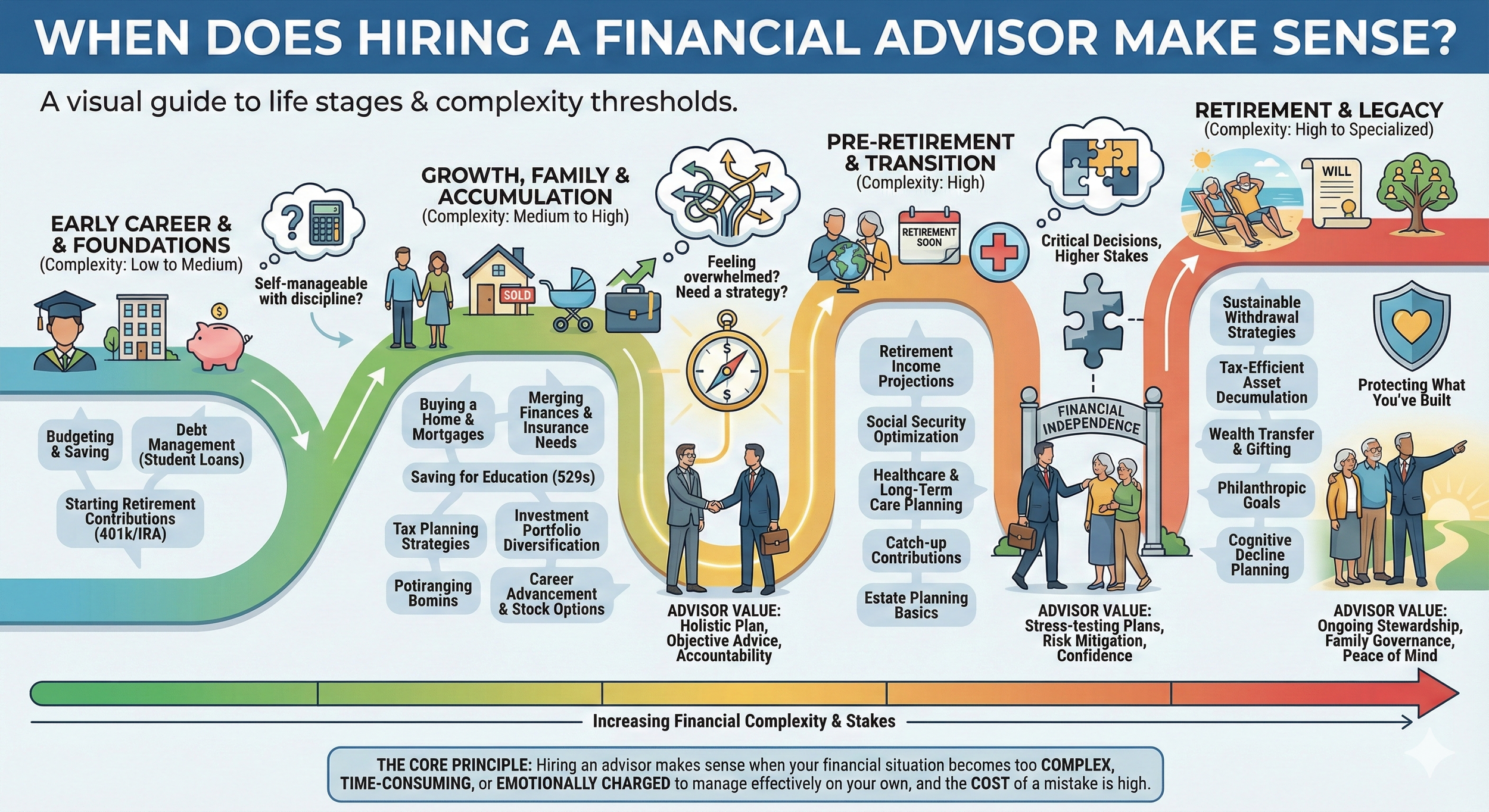
It’s not about a magic net worth number; it’s about the complexity of your life. Discover why high-earning professionals and business owners are moving away from DIY management and how to distinguish between a salesperson and a true fiduciary partner who is legally bound to put your interests first.

Retirement Planning
Most disappointing advisor relationships aren't about bad actors. They're about advisors who managed investments but never built an actual written plan. Here's how to tell the difference between the wrong advisor and simply the wrong fit.
Two portfolios can hold the same investments and still keep different amounts after taxes. The difference often comes down to asset location: which investments sit in your traditional, Roth, HSA, and taxable accounts. This piece walks through how each account type is taxed, the two lenses that guide placement decisions, and how to move an existing portfolio toward better location without triggering an avoidable tax bill along the way.
The S&P 500 closed the first half of 2026 up 10.21%, but the path was anything but smooth. A new Fed chair, an Iran war that pushed oil past $100, and growing scrutiny of AI earnings concentration all shaped the six months, and may shape the next. Here's a look back, plus the portfolio questions worth asking now.
"Just buy an S&P 500 fund and chill" or (VOO & Chill) is a popular strategy, but is it really just a concentrated bet on U.S. large-cap stocks? Here's what the lost decade, Japan's 34-year flat market, and decades of research on size and value suggest about using a single index for your entire portfolio.
You already know what you need to do with your money. Set up the account, look at the retirement contributions, make a plan. You've known for a while. This piece looks at why the gap between intention and action is so hard to close, what the research on financial procrastination and present bias actually says, and the one simple thing that tends to move people from "meaning to" into "done."
RSUs vesting every year, stock options you've been meaning to deal with, and a nagging sense you're overdue for a plan. The hard part usually isn't understanding the rules; it's follow-through, since there's always a reason to wait one more quarter. This piece covers how RSUs, NSOs, ISOs, and PSUs are taxed, why a concentrated position is riskier than it feels, and a three-sleeve framework for reducing it on a schedule you set in advance.
When couples combine finances, the real challenges are rarely about math. They're about autonomy, fairness, and trust. This guide walks through four approaches to merging money (from fully separate to fully joint), explains how financial needs shift across life stages, and outlines the legal risks of changing asset titling without professional counsel. Written for high-earning professionals navigating income disparity, career transitions, and the emotional weight of financial intimacy.
A Roth conversion is one of those moves that sounds technical but comes down to a simple idea: pay tax on retirement money when your rate is low instead of when it's high. This piece covers how conversions work, when to skip one (the timing traps that catch people are just as important), and a second strategy, the mega backdoor Roth, that lets high earners who've maxed their 401(k) set aside a large additional amount each year.
A few strong years in the market tend to leave portfolios holding more stock, and more risk, than their owners intended. The start of a new year is a natural time to check whether your allocation has drifted, whether your cash is doing its job, and whether you're taking full advantage of the 2026 contribution limits. This piece is a practical review across diversification, rebalancing, tax efficiency, and retirement savings by career stage.
It’s not about a magic net worth number; it’s about the complexity of your life. Discover why high-earning professionals and business owners are moving away from DIY management and how to distinguish between a salesperson and a true fiduciary partner who is legally bound to put your interests first.



Healthcare expenses are a critical and often unpredictable component of any financial plan. As a successful professional, you can't afford to let surprise medical bills compromise your long-term goals for asset growth and legacy preservation. Our strategic framework outlines eight actionable steps to help you move from reactive expense management to proactive financial control. We'll show you how to leverage tax-advantaged accounts, optimize your insurance coverage, and integrate long-term care planning to safeguard your wealth against the rising cost of health.


We’ve all felt the anxiety when the market hits a new all-time high. But what if that feeling is based on a media narratives and emotion, rather than logic? We'll use data to explain why the market isn't defying anything, it's just doing its job; and why staying the course on a well-defined plan is more important than timing the market.



Your business is a rocket ship; an unparalleled engine for wealth creation. But relying on it for 100% of your net worth creates a dangerous concentration risk and is one of the biggest financial mistakes an owner can make. The single most important move for your family's long-term security is to consistently and strategically move money out of your business. This video is not about being less committed to your company; it’s about building a financial fortress around it. We break down the four critical strategies for building your family's "Mission Command": a structure of outside assets that protects your wealth, funds your life, diversifies your tax strategy, and secures your legacy for generations to come. Are you the CEO of your business, or the CEO of your family's future?




A popular stat suggests indexing the S&P 500 would have been a better investment than Jerry Buss's purchase of the Lakers. This article dismantles that myth, revealing how the real math of leverage, cash flow, and tax efficiency tells a much different, and more profitable, story about building true wealth through ownership.
Entrepreneurs
When couples combine finances, the real challenges are rarely about math. They're about autonomy, fairness, and trust. This guide walks through four approaches to merging money (from fully separate to fully joint), explains how financial needs shift across life stages, and outlines the legal risks of changing asset titling without professional counsel. Written for high-earning professionals navigating income disparity, career transitions, and the emotional weight of financial intimacy.
It’s not about a magic net worth number; it’s about the complexity of your life. Discover why high-earning professionals and business owners are moving away from DIY management and how to distinguish between a salesperson and a true fiduciary partner who is legally bound to put your interests first.
Healthcare expenses are a critical and often unpredictable component of any financial plan. As a successful professional, you can't afford to let surprise medical bills compromise your long-term goals for asset growth and legacy preservation. Our strategic framework outlines eight actionable steps to help you move from reactive expense management to proactive financial control. We'll show you how to leverage tax-advantaged accounts, optimize your insurance coverage, and integrate long-term care planning to safeguard your wealth against the rising cost of health.
We’ve all felt the anxiety when the market hits a new all-time high. But what if that feeling is based on a media narratives and emotion, rather than logic? We'll use data to explain why the market isn't defying anything, it's just doing its job; and why staying the course on a well-defined plan is more important than timing the market.
Your business is a rocket ship; an unparalleled engine for wealth creation. But relying on it for 100% of your net worth creates a dangerous concentration risk and is one of the biggest financial mistakes an owner can make. The single most important move for your family's long-term security is to consistently and strategically move money out of your business. This video is not about being less committed to your company; it’s about building a financial fortress around it. We break down the four critical strategies for building your family's "Mission Command": a structure of outside assets that protects your wealth, funds your life, diversifies your tax strategy, and secures your legacy for generations to come. Are you the CEO of your business, or the CEO of your family's future?
A popular stat suggests indexing the S&P 500 would have been a better investment than Jerry Buss's purchase of the Lakers. This article dismantles that myth, revealing how the real math of leverage, cash flow, and tax efficiency tells a much different, and more profitable, story about building true wealth through ownership.

Feeling 'good enough' about your finances, especially compared to others? This common mindset might be a trap. Discover why simply 'keeping up' falls short and how a financial plan truly 'right for you' can secure your ambitions.

Compare business structures like LLC, S-Corp, C-Corp, & more. Learn how each impacts your taxes, personal liability, and growth.

Transferring a business to family members is more than just a financial decision, it’s a deeply personal one. Your business represents years, if not decades, of hard work, sacrifice, and dedication. It’s a legacy that you want to see thrive for generations to come. However, without proper planning, a transition can create unnecessary tax burdens, financial strain, and even family disputes. Understanding the available strategies ensures that your business remains a source of security, not stress, for your loved ones.

A cash balance plan helps business owners save more for retirement while lowering taxes. With higher contribution limits than a 401(k) and tax-deferred growth, these plans offer major financial advantages. Employers fund the plan, providing stable benefits for employees. While they require annual contributions and administration, the tax savings and wealth-building potential make them a smart choice for high-income professionals.

Estate planning goes beyond preserving wealth; it’s a strategic approach to financial security, tax efficiency, and legacy building. This guide explores advanced estate planning techniques, including trusts, business succession strategies, and philanthropic giving, to help you safeguard assets and optimize wealth transfer. Whether managing a business or planning for future generations, these insights ensure a comprehensive and tax-efficient estate plan.

Discover strategies to maximize owner compensation, attract and retain key employees, and foster long-term business success with tailored incentives, equity-based rewards, and retention-focused programs.

Managing wealth when your largest asset is real estate requires thoughtful strategies. From tax-efficient tools like 1031 exchanges to diversification through DSTs and UPREITs, each option offers unique benefits and trade-offs. Finding the right path depends on balancing growth, liquidity, and long-term goals while navigating the complexities of real estate investment.

The Supreme Court's Connelly decision reshapes estate planning and buy-sell agreements for business owners.

For business owners, the importance of buy/sell agreements cannot be overstated. These contracts are designed to protect both the business and its owners by setting clear guidelines for ownership transitions in case of unforeseen events such as death, disability, or retirement. Without such an agreement, businesses can face severe disruptions, leading to internal disputes or financial strain.
A buy/sell agreement helps ensure that ownership changes are handled smoothly by defining how shares will be sold and at what price. More importantly, it prevents the business from falling into the hands of unintended parties, like an owner’s ex-spouse or an outsider who could negatively impact the company’s operations.
By incorporating key provisions such as purchase price determination and funding mechanisms, buy/sell agreements give businesses a solid foundation for navigating ownership transitions, ultimately protecting their long-term success.

Passing on wealth to the next generation is more than just managing financial assets—it's about ensuring your values, wisdom, and legacy endure. This article explores simple strategies to transfer both financial and qualitative capital, helping you create a lasting legacy for your family.


Discover the power of a family bank: transform your wealth management. Many American families face the challenge of preserving and growing their wealth across generations. The concept of a family bank offers a robust solution, providing a structured system to manage and utilize family wealth effectively.


Relationships & Money
Most disappointing advisor relationships aren't about bad actors. They're about advisors who managed investments but never built an actual written plan. Here's how to tell the difference between the wrong advisor and simply the wrong fit.
Two portfolios can hold the same investments and still keep different amounts after taxes. The difference often comes down to asset location: which investments sit in your traditional, Roth, HSA, and taxable accounts. This piece walks through how each account type is taxed, the two lenses that guide placement decisions, and how to move an existing portfolio toward better location without triggering an avoidable tax bill along the way.
The S&P 500 closed the first half of 2026 up 10.21%, but the path was anything but smooth. A new Fed chair, an Iran war that pushed oil past $100, and growing scrutiny of AI earnings concentration all shaped the six months, and may shape the next. Here's a look back, plus the portfolio questions worth asking now.
"Just buy an S&P 500 fund and chill" or (VOO & Chill) is a popular strategy, but is it really just a concentrated bet on U.S. large-cap stocks? Here's what the lost decade, Japan's 34-year flat market, and decades of research on size and value suggest about using a single index for your entire portfolio.
You already know what you need to do with your money. Set up the account, look at the retirement contributions, make a plan. You've known for a while. This piece looks at why the gap between intention and action is so hard to close, what the research on financial procrastination and present bias actually says, and the one simple thing that tends to move people from "meaning to" into "done."
RSUs vesting every year, stock options you've been meaning to deal with, and a nagging sense you're overdue for a plan. The hard part usually isn't understanding the rules; it's follow-through, since there's always a reason to wait one more quarter. This piece covers how RSUs, NSOs, ISOs, and PSUs are taxed, why a concentrated position is riskier than it feels, and a three-sleeve framework for reducing it on a schedule you set in advance.
When couples combine finances, the real challenges are rarely about math. They're about autonomy, fairness, and trust. This guide walks through four approaches to merging money (from fully separate to fully joint), explains how financial needs shift across life stages, and outlines the legal risks of changing asset titling without professional counsel. Written for high-earning professionals navigating income disparity, career transitions, and the emotional weight of financial intimacy.
Ask people why they hired a financial advisor and almost none of them say "to beat the market." They say they wanted accountability, help making sense of complexity, or simply to stop spending their weekends on it. This piece walks through where research suggests professional management may add value over time, from cost-effective implementation and rebalancing to tax and withdrawal planning, and why the largest contribution tends to be keeping investors from costly decisions at market extremes.
You track your steps, hit the gym, and meal prep. Financial health rarely gets the same attention, even though money is the leading factor Americans point to when they talk about what's hurting their mental health. This piece reframes financial wellness as a form of wellness rather than a chore, walks through six areas it actually covers, and looks at what the research says about where guidance tends to help most.
It’s not about a magic net worth number; it’s about the complexity of your life. Discover why high-earning professionals and business owners are moving away from DIY management and how to distinguish between a salesperson and a true fiduciary partner who is legally bound to put your interests first.
Healthcare expenses are a critical and often unpredictable component of any financial plan. As a successful professional, you can't afford to let surprise medical bills compromise your long-term goals for asset growth and legacy preservation. Our strategic framework outlines eight actionable steps to help you move from reactive expense management to proactive financial control. We'll show you how to leverage tax-advantaged accounts, optimize your insurance coverage, and integrate long-term care planning to safeguard your wealth against the rising cost of health.
We’ve all felt the anxiety when the market hits a new all-time high. But what if that feeling is based on a media narratives and emotion, rather than logic? We'll use data to explain why the market isn't defying anything, it's just doing its job; and why staying the course on a well-defined plan is more important than timing the market.
Your business is a rocket ship; an unparalleled engine for wealth creation. But relying on it for 100% of your net worth creates a dangerous concentration risk and is one of the biggest financial mistakes an owner can make. The single most important move for your family's long-term security is to consistently and strategically move money out of your business. This video is not about being less committed to your company; it’s about building a financial fortress around it. We break down the four critical strategies for building your family's "Mission Command": a structure of outside assets that protects your wealth, funds your life, diversifies your tax strategy, and secures your legacy for generations to come. Are you the CEO of your business, or the CEO of your family's future?
A popular stat suggests indexing the S&P 500 would have been a better investment than Jerry Buss's purchase of the Lakers. This article dismantles that myth, revealing how the real math of leverage, cash flow, and tax efficiency tells a much different, and more profitable, story about building true wealth through ownership.

Feeling 'good enough' about your finances, especially compared to others? This common mindset might be a trap. Discover why simply 'keeping up' falls short and how a financial plan truly 'right for you' can secure your ambitions.

Compare business structures like LLC, S-Corp, C-Corp, & more. Learn how each impacts your taxes, personal liability, and growth.
Transferring a business to family members is more than just a financial decision, it’s a deeply personal one. Your business represents years, if not decades, of hard work, sacrifice, and dedication. It’s a legacy that you want to see thrive for generations to come. However, without proper planning, a transition can create unnecessary tax burdens, financial strain, and even family disputes. Understanding the available strategies ensures that your business remains a source of security, not stress, for your loved ones.
Insurance
When couples combine finances, the real challenges are rarely about math. They're about autonomy, fairness, and trust. This guide walks through four approaches to merging money (from fully separate to fully joint), explains how financial needs shift across life stages, and outlines the legal risks of changing asset titling without professional counsel. Written for high-earning professionals navigating income disparity, career transitions, and the emotional weight of financial intimacy.
It’s not about a magic net worth number; it’s about the complexity of your life. Discover why high-earning professionals and business owners are moving away from DIY management and how to distinguish between a salesperson and a true fiduciary partner who is legally bound to put your interests first.
Healthcare expenses are a critical and often unpredictable component of any financial plan. As a successful professional, you can't afford to let surprise medical bills compromise your long-term goals for asset growth and legacy preservation. Our strategic framework outlines eight actionable steps to help you move from reactive expense management to proactive financial control. We'll show you how to leverage tax-advantaged accounts, optimize your insurance coverage, and integrate long-term care planning to safeguard your wealth against the rising cost of health.
We’ve all felt the anxiety when the market hits a new all-time high. But what if that feeling is based on a media narratives and emotion, rather than logic? We'll use data to explain why the market isn't defying anything, it's just doing its job; and why staying the course on a well-defined plan is more important than timing the market.
Your business is a rocket ship; an unparalleled engine for wealth creation. But relying on it for 100% of your net worth creates a dangerous concentration risk and is one of the biggest financial mistakes an owner can make. The single most important move for your family's long-term security is to consistently and strategically move money out of your business. This video is not about being less committed to your company; it’s about building a financial fortress around it. We break down the four critical strategies for building your family's "Mission Command": a structure of outside assets that protects your wealth, funds your life, diversifies your tax strategy, and secures your legacy for generations to come. Are you the CEO of your business, or the CEO of your family's future?
A popular stat suggests indexing the S&P 500 would have been a better investment than Jerry Buss's purchase of the Lakers. This article dismantles that myth, revealing how the real math of leverage, cash flow, and tax efficiency tells a much different, and more profitable, story about building true wealth through ownership.
Feeling 'good enough' about your finances, especially compared to others? This common mindset might be a trap. Discover why simply 'keeping up' falls short and how a financial plan truly 'right for you' can secure your ambitions.
Compare business structures like LLC, S-Corp, C-Corp, & more. Learn how each impacts your taxes, personal liability, and growth.
Transferring a business to family members is more than just a financial decision, it’s a deeply personal one. Your business represents years, if not decades, of hard work, sacrifice, and dedication. It’s a legacy that you want to see thrive for generations to come. However, without proper planning, a transition can create unnecessary tax burdens, financial strain, and even family disputes. Understanding the available strategies ensures that your business remains a source of security, not stress, for your loved ones.
A cash balance plan helps business owners save more for retirement while lowering taxes. With higher contribution limits than a 401(k) and tax-deferred growth, these plans offer major financial advantages. Employers fund the plan, providing stable benefits for employees. While they require annual contributions and administration, the tax savings and wealth-building potential make them a smart choice for high-income professionals.
Estate planning goes beyond preserving wealth; it’s a strategic approach to financial security, tax efficiency, and legacy building. This guide explores advanced estate planning techniques, including trusts, business succession strategies, and philanthropic giving, to help you safeguard assets and optimize wealth transfer. Whether managing a business or planning for future generations, these insights ensure a comprehensive and tax-efficient estate plan.
Discover strategies to maximize owner compensation, attract and retain key employees, and foster long-term business success with tailored incentives, equity-based rewards, and retention-focused programs.
Managing wealth when your largest asset is real estate requires thoughtful strategies. From tax-efficient tools like 1031 exchanges to diversification through DSTs and UPREITs, each option offers unique benefits and trade-offs. Finding the right path depends on balancing growth, liquidity, and long-term goals while navigating the complexities of real estate investment.
The Supreme Court's Connelly decision reshapes estate planning and buy-sell agreements for business owners.

For business owners, the importance of buy/sell agreements cannot be overstated. These contracts are designed to protect both the business and its owners by setting clear guidelines for ownership transitions in case of unforeseen events such as death, disability, or retirement. Without such an agreement, businesses can face severe disruptions, leading to internal disputes or financial strain.
A buy/sell agreement helps ensure that ownership changes are handled smoothly by defining how shares will be sold and at what price. More importantly, it prevents the business from falling into the hands of unintended parties, like an owner’s ex-spouse or an outsider who could negatively impact the company’s operations.
By incorporating key provisions such as purchase price determination and funding mechanisms, buy/sell agreements give businesses a solid foundation for navigating ownership transitions, ultimately protecting their long-term success.


One of my favorite tax strategies for college professors and others is a Health Savings Account (HSA) offered through your workplace. Read more about three steps to take full tax advantage of your HSA: 1) make maximum contributions, 2) invest in stocks and bonds, 3) delay withdrawals as long as possible.


The media and the average person misunderstand and misinterpret inflation for two important reasons:
They focus on the ANNUAL reported inflation number which tells you what has happened over the past year but not where inflation is headed.
The SHELTER component of inflation which measures rents and home prices makes up about one third of overall inflation but lags real-time housing data by up to 12 months.
The most recent inflation report that was published on 12/13/2022 makes an excellent illustration of these two points. Understanding the nuance of inflation reports and where we are headed rather than where we have been is key for setting expectations for how much further and how quickly the Fed will continue to raise interest rates as well as how long rates will remain elevated.

How to decide what to renovate, how much renovations cost, cash versus home equity loans, your realistic investment return, and so. much. more.


Housing
Sales Professionals
RSUs vesting every year, stock options you've been meaning to deal with, and a nagging sense you're overdue for a plan. The hard part usually isn't understanding the rules; it's follow-through, since there's always a reason to wait one more quarter. This piece covers how RSUs, NSOs, ISOs, and PSUs are taxed, why a concentrated position is riskier than it feels, and a three-sleeve framework for reducing it on a schedule you set in advance.


Miscellaneous
Most disappointing advisor relationships aren't about bad actors. They're about advisors who managed investments but never built an actual written plan. Here's how to tell the difference between the wrong advisor and simply the wrong fit.
Two portfolios can hold the same investments and still keep different amounts after taxes. The difference often comes down to asset location: which investments sit in your traditional, Roth, HSA, and taxable accounts. This piece walks through how each account type is taxed, the two lenses that guide placement decisions, and how to move an existing portfolio toward better location without triggering an avoidable tax bill along the way.
The S&P 500 closed the first half of 2026 up 10.21%, but the path was anything but smooth. A new Fed chair, an Iran war that pushed oil past $100, and growing scrutiny of AI earnings concentration all shaped the six months, and may shape the next. Here's a look back, plus the portfolio questions worth asking now.
"Just buy an S&P 500 fund and chill" or (VOO & Chill) is a popular strategy, but is it really just a concentrated bet on U.S. large-cap stocks? Here's what the lost decade, Japan's 34-year flat market, and decades of research on size and value suggest about using a single index for your entire portfolio.
You already know what you need to do with your money. Set up the account, look at the retirement contributions, make a plan. You've known for a while. This piece looks at why the gap between intention and action is so hard to close, what the research on financial procrastination and present bias actually says, and the one simple thing that tends to move people from "meaning to" into "done."
RSUs vesting every year, stock options you've been meaning to deal with, and a nagging sense you're overdue for a plan. The hard part usually isn't understanding the rules; it's follow-through, since there's always a reason to wait one more quarter. This piece covers how RSUs, NSOs, ISOs, and PSUs are taxed, why a concentrated position is riskier than it feels, and a three-sleeve framework for reducing it on a schedule you set in advance.
When couples combine finances, the real challenges are rarely about math. They're about autonomy, fairness, and trust. This guide walks through four approaches to merging money (from fully separate to fully joint), explains how financial needs shift across life stages, and outlines the legal risks of changing asset titling without professional counsel. Written for high-earning professionals navigating income disparity, career transitions, and the emotional weight of financial intimacy.
Ask people why they hired a financial advisor and almost none of them say "to beat the market." They say they wanted accountability, help making sense of complexity, or simply to stop spending their weekends on it. This piece walks through where research suggests professional management may add value over time, from cost-effective implementation and rebalancing to tax and withdrawal planning, and why the largest contribution tends to be keeping investors from costly decisions at market extremes.
You track your steps, hit the gym, and meal prep. Financial health rarely gets the same attention, even though money is the leading factor Americans point to when they talk about what's hurting their mental health. This piece reframes financial wellness as a form of wellness rather than a chore, walks through six areas it actually covers, and looks at what the research says about where guidance tends to help most.
A Roth conversion is one of those moves that sounds technical but comes down to a simple idea: pay tax on retirement money when your rate is low instead of when it's high. This piece covers how conversions work, when to skip one (the timing traps that catch people are just as important), and a second strategy, the mega backdoor Roth, that lets high earners who've maxed their 401(k) set aside a large additional amount each year.
A few strong years in the market tend to leave portfolios holding more stock, and more risk, than their owners intended. The start of a new year is a natural time to check whether your allocation has drifted, whether your cash is doing its job, and whether you're taking full advantage of the 2026 contribution limits. This piece is a practical review across diversification, rebalancing, tax efficiency, and retirement savings by career stage.
A government shutdown delayed key data, rate expectations shifted, and headlines stayed loud, yet 2025 ended up a solid year for disciplined investors. The more interesting story was where the returns came from: international stocks outpaced the U.S. by a wide margin, and bonds posted their best year since 2020. This recap looks back at what happened and why staying diversified, rather than chasing last year's leader, tends to hold up.
It’s not about a magic net worth number; it’s about the complexity of your life. Discover why high-earning professionals and business owners are moving away from DIY management and how to distinguish between a salesperson and a true fiduciary partner who is legally bound to put your interests first.
Healthcare expenses are a critical and often unpredictable component of any financial plan. As a successful professional, you can't afford to let surprise medical bills compromise your long-term goals for asset growth and legacy preservation. Our strategic framework outlines eight actionable steps to help you move from reactive expense management to proactive financial control. We'll show you how to leverage tax-advantaged accounts, optimize your insurance coverage, and integrate long-term care planning to safeguard your wealth against the rising cost of health.
We’ve all felt the anxiety when the market hits a new all-time high. But what if that feeling is based on a media narratives and emotion, rather than logic? We'll use data to explain why the market isn't defying anything, it's just doing its job; and why staying the course on a well-defined plan is more important than timing the market.
Your business is a rocket ship; an unparalleled engine for wealth creation. But relying on it for 100% of your net worth creates a dangerous concentration risk and is one of the biggest financial mistakes an owner can make. The single most important move for your family's long-term security is to consistently and strategically move money out of your business. This video is not about being less committed to your company; it’s about building a financial fortress around it. We break down the four critical strategies for building your family's "Mission Command": a structure of outside assets that protects your wealth, funds your life, diversifies your tax strategy, and secures your legacy for generations to come. Are you the CEO of your business, or the CEO of your family's future?
A popular stat suggests indexing the S&P 500 would have been a better investment than Jerry Buss's purchase of the Lakers. This article dismantles that myth, revealing how the real math of leverage, cash flow, and tax efficiency tells a much different, and more profitable, story about building true wealth through ownership.
Firm Updates


The Best TV We’ve Ever Seen
Tired of boring financial jargon? John Oliver cuts through the noise with sharp wit and plain english to reveal what’s really going on in the financial world. It’s funny, eye-opening, and totally worth the watch (just maybe not with the kids around).
